

Percentage Change Calculator
Calculate the percentage increase or decrease between an initial value and a final value with step-by-step breakdown.
About the Percentage Change Calculator
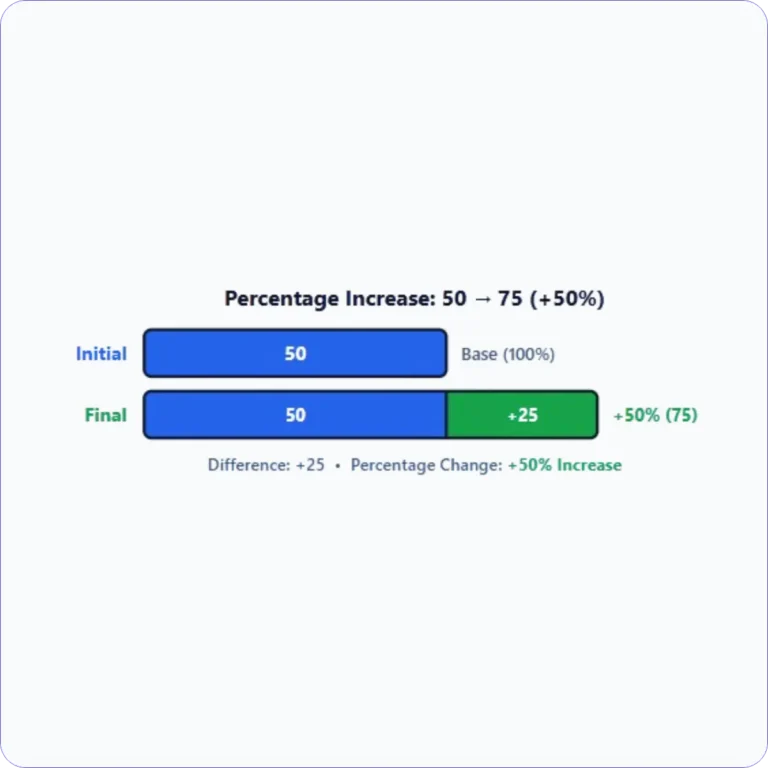
Percentage change measures how much a quantity has grown (percentage increase) or shrunk (percentage decrease) relative to its starting value. It is essential in economics, stock market analysis, revenue growth tracking, and science experiments.
Our Percentage Change Calculator computes the exact difference between an old value and a new value, determines whether it is an increase or decrease, and shows the multiplier ratio.
Percentage Increase & Decrease Formula
Given an initial value V₁ (Old) and a final value V₂ (New):
% Change = ((V₂ − V₁) / |V₁|) × 100%% Increase = ((New − Old) / Old) × 100%% Decrease = ((Old − New) / Old) × 100%How to Find Percentage Change
- Subtract the Old Value from the New Value: Compute
Difference = V₂ − V₁. A positive difference indicates an increase; a negative difference indicates a decrease. - Divide by the Original (Old) Value: Divide the difference by
V₁. - Multiply by 100: Multiply the decimal result by 100 and attach the
%sign.
Worked Example: If a price rises from 50 to 75, the difference is 75 − 50 = 25. Divide by the starting value 50: 25 ÷ 50 = 0.5. Multiply by 100 to get a 50% increase.
Frequently Asked Questions (FAQ)
Why is a 50% increase followed by a 50% decrease not back to the original number?
Because the second percentage is calculated from the new base value! Increasing 100 by 50% gives 150, and decreasing 150 by 50% subtracts 75, leaving 75.
What is the difference between percentage change and percentage difference?
Percentage change compares a new value against a specific starting value (dividing by V₁), whereas percentage difference compares two peers without a time order by dividing by their average.
Was this calculator helpful?
Help us improve our free step-by-step tools