

Fraction to Decimal Calculator
Convert any fraction into an exact or rounded decimal number (or decimal to fraction) with step-by-step division explanation.
About the Fraction to Decimal Calculator
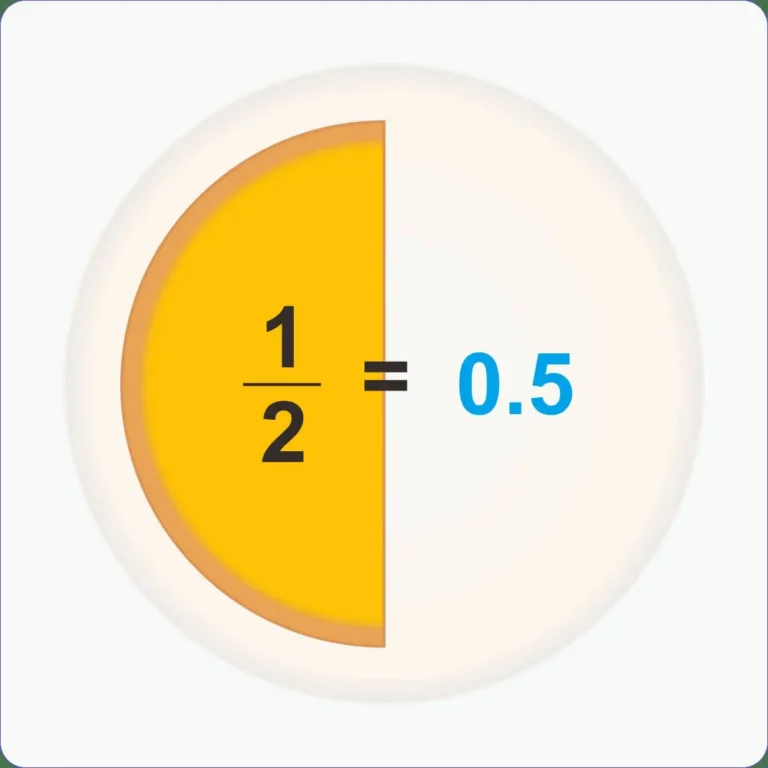
Fractions and decimals are two different ways of expressing the same numerical value. Converting a fraction into a decimal makes it easy to compare values, use standard calculators, and record measurements in metric or financial systems.
This Fraction to Decimal Calculator converts any fraction into a terminating or rounded decimal—and also converts decimals back into simplified fractions—with step-by-step division explanations.
Fraction to Decimal Formula
Every fraction bar represents division. To convert a fraction to a decimal, divide the numerator by the denominator:
Decimal = Numerator ÷ DenominatorW (n/d) = W + (n ÷ d)Decimal = (Decimal × 10^k) / 10^k (then simplify by GCD)How to Convert a Fraction to a Decimal
- Reduce the Fraction (Optional): Simplifying the fraction first makes long division smaller and faster.
- Set Up the Division: Divide the top number (numerator) by the bottom number (denominator).
- Use Long Division or Power-of-10 Scaling: If the denominator is a factor of 10, 100, or 1000 (such as 2, 4, 5, 8, 20, 25), multiply top and bottom to reach that power of 10 and shift the decimal point.
Worked Example: To convert 3/8 to a decimal, divide 3 by 8: 3 ÷ 8 = 0.375. Alternatively, multiply top and bottom by 125 to get 375/1000 = 0.375.
Frequently Asked Questions (FAQ)
When does a fraction produce a repeating decimal?
A simplified fraction produces a terminating decimal if and only if its denominator has no prime factors other than 2 and 5. Denominators with prime factors like 3, 6, 7, 9, or 11 produce repeating decimals (such as 1/3 = 0.333…).
How do I convert a decimal like 0.75 back into a fraction?
Write 0.75 over 100 (since there are 2 decimal places) to get 75/100, then divide both numbers by their GCD (25) to get 3/4.
Was this calculator helpful?
Help us improve our free step-by-step tools