

Mixed Numbers Calculator
Add, subtract, multiply, and divide mixed numbers (whole numbers and fractions combined) with automatic improper fraction conversion.
About the Mixed Numbers Calculator
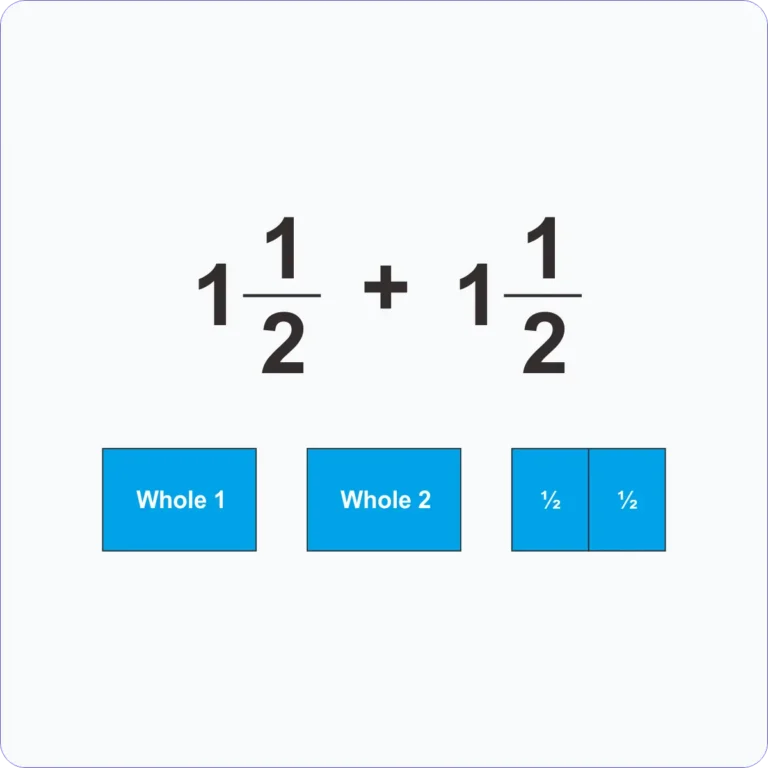
A mixed number (or mixed fraction) is a value that combines a non-zero whole integer and a proper fraction, such as 2 1/2 or 3 3/4. Mixed numbers are widely used in everyday measurements, cooking recipes, carpentry, and imperial units.
This Mixed Numbers Calculator adds, subtracts, multiplies, and divides mixed numbers by automatically converting them into improper fractions, performing the exact arithmetic operation, and converting the simplified answer back into both mixed number and decimal forms.
Mixed Number Conversion & Operation Formulas
To perform arithmetic on mixed numbers W₁ (n₁/d₁) and W₂ (n₂/d₂), convert each mixed number into an improper fraction first:
W (n/d) = ((W × d) + n) / dN / D = Quotient (Remainder / D)W₁(n₁/d₁) + W₂(n₂/d₂) = ((W₁d₁ + n₁)/d₁) + ((W₂d₂ + n₂)/d₂)How to Calculate with Mixed Numbers (Step-by-Step)
- Convert Mixed Numbers to Improper Fractions: Multiply each whole number by its fraction’s denominator, add the numerator, and place the result over the original denominator.
- Perform the Fraction Operation: For addition or subtraction, find the Least Common Denominator (LCD) and combine numerators. For multiplication, multiply straight across. For division, multiply by the reciprocal of the second improper fraction.
- Reduce the Resulting Fraction: Divide the numerator and denominator by their Greatest Common Factor (GCF).
- Convert Back to a Mixed Number: Divide the simplified numerator by the denominator. The quotient becomes the whole number, and the remainder becomes the new numerator.
Worked Example: To solve 2 1/2 + 1 3/4, convert to improper fractions: 5/2 + 7/4. Using LCD = 4, rewrite 5/2 as 10/4. Add: 10/4 + 7/4 = 17/4, which converts to 4 1/4 (or 4.25).
Frequently Asked Questions (FAQ)
Can I add the whole numbers and fractions separately?
Yes, for addition you can add the whole numbers together and the fractions together, then carry over any improper fraction into the whole number. However, converting to improper fractions first works universally for subtraction, multiplication, and division without borrowing errors.
How do you multiply two mixed numbers?
Always convert both mixed numbers into improper fractions first, multiply the numerators together and denominators together, and then convert the product back into a mixed number.
How do you subtract mixed numbers when the second fraction is larger?
Converting both mixed numbers into improper fractions eliminates the need to borrow from the whole number and prevents common subtraction mistakes.
Was this calculator helpful?
Help us improve our free step-by-step tools