

Decimal to Fraction Calculator
Convert any terminating or repeating decimal number into its simplest fraction and mixed number form step by step.
About the Decimal to Fraction Calculator
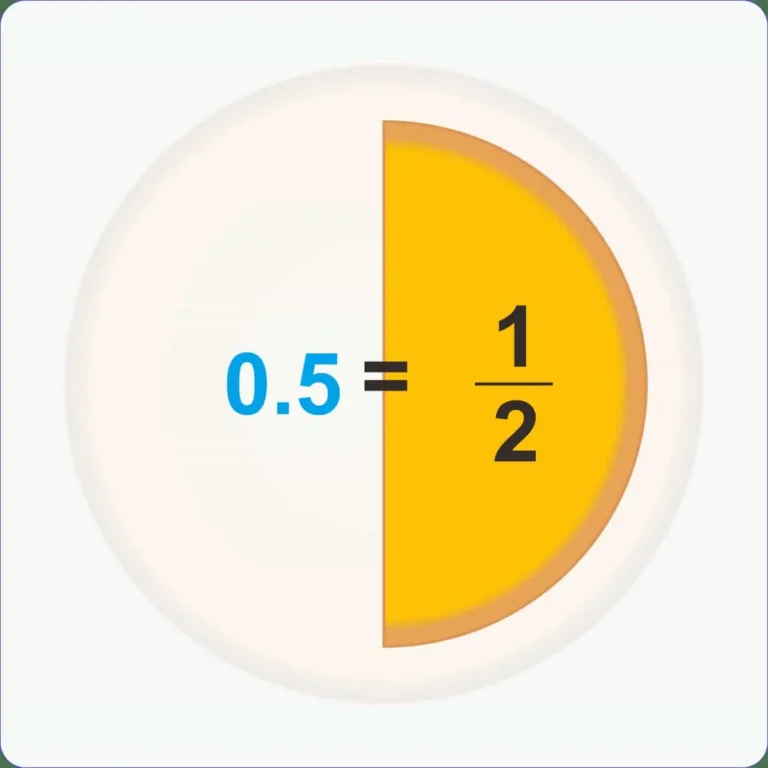
Every terminating decimal number represents a fraction whose denominator is a power of ten (10, 100, 1,000, etc.). Converting a decimal into a simplified fraction is essential in carpentry, machining, cooking, and algebra where exact fractional ratios are preferred over decimals.
Our Decimal to Fraction Calculator converts any decimal number (such as 0.75, 0.125, or 1.25) into its lowest-terms proper fraction, improper fraction, and mixed number—showing the exact power-of-10 multiplication and Greatest Common Divisor (GCD) reduction.
Decimal to Fraction Conversion Formula
For a decimal number D with k digits after the decimal point, multiply top and bottom by 10^k and simplify:
D = (D × 10^k) / 10^kNumerator = (D × 10^k) ÷ GCD, Denominator = 10^k ÷ GCDWhole Part = floor(D), Fractional Part = (D − floor(D)) as reduced fractionHow to Convert a Decimal to a Fraction (Step-by-Step)
- Write the Decimal Over 1: Express the decimal number
Das a fraction with 1 in the denominator (D / 1). - Count the Decimal Places (k): Count how many digits appear to the right of the decimal point. Multiply both numerator and denominator by
10^k(10 for 1 digit, 100 for 2 digits, 1,000 for 3 digits) to eliminate the decimal point. - Find the Greatest Common Divisor (GCD): Determine the largest integer that divides both the new whole-number numerator and the power-of-10 denominator.
- Divide to Simplify: Divide both numerator and denominator by their GCD. If the numerator is larger than the denominator, convert the improper fraction into a mixed number.
Worked Example: To convert 0.75 to a fraction, write 0.75 / 1. Since there are 2 decimal places, multiply top and bottom by 100 to get 75 / 100. Divide both by GCD(75, 100) = 25 to get 3/4.
Frequently Asked Questions (FAQ)
How do you convert a decimal greater than 1 into a fraction?
You can either keep the whole number separate and convert only the decimal part into a proper fraction (e.g., 1.25 = 1 + 25/100 = 1 1/4), or multiply the entire number by 10^k (125/100) and simplify to the improper fraction 5/4.
How do you convert repeating decimals like 0.333… or 0.666… into fractions?
A single repeating digit sits over 9 instead of 10: 0.333… = 3/9 = 1/3, and 0.666… = 6/9 = 2/3. Two repeating digits sit over 99 (for example, 0.0909… = 9/99 = 1/11).
Why do terminating decimals always have denominators with factors of 2 and 5?
Because unreduced decimal fractions always have a denominator of 10^k, and the prime factorization of 10 is 2 × 5. After reducing by the GCD, only powers of 2 and 5 can remain in the denominator.
Was this calculator helpful?
Help us improve our free step-by-step tools