

Fraction Calculator
Enter two fractions below to add, subtract, multiply, or divide with instant step-by-step solutions, LCD/GCD breakdown, and visual fraction bars.
About the Fraction Calculator
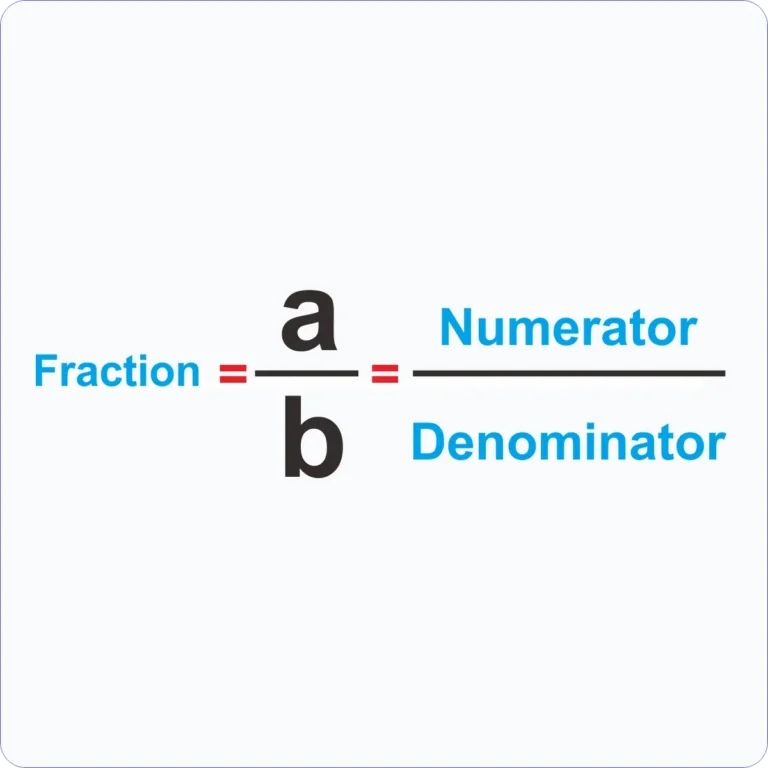
A fraction represents a part of a whole and consists of two integers: a numerator (the top number, indicating how many parts you have) and a non-zero denominator (the bottom number, indicating how many equal parts make up a whole).
Our online Fraction Calculator performs addition (+), subtraction (−), multiplication (×), and division (÷) on any two proper or improper fractions. It automatically finds the Least Common Denominator (LCD), reduces the final answer to lowest terms using the Greatest Common Divisor (GCD), and converts improper fractions into mixed numbers, decimals, and percentages.
Fraction Arithmetic Formulas
Given two fractions a/b and c/d (where b ≠ 0 and d ≠ 0), the four standard arithmetic operations follow these algebraic formulas:
a/b + c/d = (a × d + b × c) / (b × d)a/b − c/d = (a × d − b × c) / (b × d)a/b × c/d = (a × c) / (b × d)a/b ÷ c/d = a/b × d/c = (a × d) / (b × c)How to Add, Subtract, Multiply, and Divide Fractions
- Find a Common Denominator (for Addition & Subtraction): Identify the Least Common Multiple (LCM) of the two denominators
bandd. Multiply each fraction’s top and bottom so both share this Least Common Denominator (LCD). - Combine the Numerators: Add or subtract the adjusted numerators while keeping the common denominator unchanged. For multiplication, simply multiply numerator by numerator and denominator by denominator. For division, flip the second fraction (find its reciprocal) and multiply.
- Simplify Using the GCD: Find the Greatest Common Divisor (GCD) of the resulting numerator and denominator, then divide both by that number to reduce the fraction to lowest terms.
- Convert Improper Fractions (Optional): If the simplified numerator is larger than the denominator, divide the numerator by the denominator to express the result as a mixed number.
Worked Example: To calculate 1/2 + 3/4, find the LCD of 2 and 4, which is 4. Convert 1/2 to 2/4, then add the numerators: (2 + 3)/4 = 5/4, which equals 1 1/4 or 1.25.
Frequently Asked Questions (FAQ)
Why do you need a common denominator when adding or subtracting fractions?
A denominator defines the size of each fractional piece. You can only directly add or subtract pieces that are the exact same size, which is why unlike fractions must first be converted to equivalent fractions with a common denominator.
Do you need a common denominator to multiply or divide fractions?
No. When multiplying fractions, you multiply the numerators straight across and the denominators straight across. When dividing, you multiply the first fraction by the reciprocal of the second fraction.
What is the difference between a proper fraction, improper fraction, and mixed number?
A proper fraction has a numerator smaller than its denominator (e.g., 3/4). An improper fraction has a numerator greater than or equal to its denominator (e.g., 5/4). A mixed number combines a whole number and a proper fraction (e.g., 1 1/4).
How do I reduce a fraction to its simplest form?
Divide both the numerator and the denominator by their Greatest Common Divisor (GCD). When their GCD is 1, the fraction is in its simplest form.
Was this calculator helpful?
Help us improve our free step-by-step tools