
A calculator for simplifying all types of fractions, including proper, improper, and mixed.
Enter your fractions below (W optional) simple or mixed fractions. Get visual representations, decimal values, and step-by-step solutions.
Simplification Steps
How to Use the Calculator
Whether you are checking your math homework or studying for an upcoming test, this simplify fraction calculator is designed to be simple and straightforward. Follow these quick steps to get step-by-step solutions for your math problems:
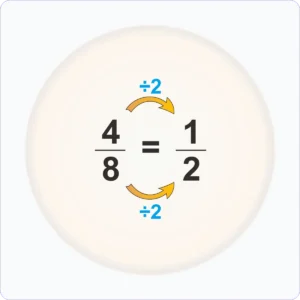
Simplifying Fractions
Simplifying a fraction means converting it to its simplest form. An easy way to do this is to divide both the numerator and the denominator by the same number until neither can be divided any further. For a basic understanding of simplifying fractions.
Example: Simplify the fractions 24 = ?
24 are both divisible by 2, so 24 = 12
You can convert a fraction to its simplest form by repeatedly dividing both the numerator and the denominator by the same number until the numerator and denominator have no common factors other than 1. The example above shows how to simplify a fraction using the step-by-step division method. There are two other methods commonly used to simplify fractions.
How this simplify calculator works?
This simplification calculator works through a structured sequence of mathematical steps to simplify proper, improper, and mixed fractions to their simplest form.
1 If the number are mixed number, this calculator converts it into an improper fraction by multiplying the absolute value of the whole number by the denominator, then adding it to the numerator.
2 The calculator determines the Greatest Common Factor (GCF) of the numerator and denominator using the Euclidean algorithm, which relies on the formula
to repeatedly divide the numbers and find the remainder until the remainder reaches zero. Once the GCD is found, both the numerator and denominator are divided by that common factor to produce a fully simplified fraction.
3 If the simplified fraction is an improper fraction, meaning the numerator is greater than or equal to the denominator, the calculator will convert it back to a mixed number by dividing the numerator by the denominator to obtain the whole number part and calculating the remaining numerator value.
4 Finally, the calculator computes the equivalent decimal value by dividing the original improper fraction’s numerator by the denominator and rounding it to five decimal places.