
To easily understand the concept of fractions, let’s look at an example from our daily life. One simple example is pizza. A whole small-sized pizza is usually cut into four equal slices, which means each slice represents 14 of the entire pizza.
🍕 Fraction Pizza Slicer
Try yourself: Drag a line across the center of the pizza to divide it into fractions.
From the pizza example above, since one small pizza is divided into four equal parts, each slice represents a fraction of 14 of the whole pizza. This means that if you eat one slice (One-Quarter), the remaining pizza is worth 34.
Another examples of fractions in Real life, when someone says, “Give it another 30 minutes.” This means 3060, or simplified as 12 hour (half of a full hour, which contains 60 minutes).
Or when shopping, we often see promotional labels like “Half Price” or “50% Off” which actually represent the fraction 12 of the item’s normal price.
With so many examples above, learning about fractions is very important. In this article, we’ll cover fractions in detail, complete with interactive explanations.
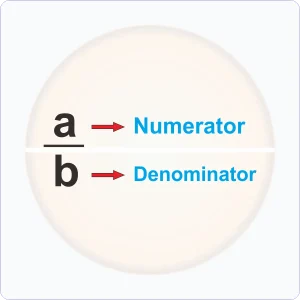
Parts of a Fraction
A fraction is a part of a whole. If an object is divided into two equal parts, the value of each part is one-half or half of the total number of objects.
A fraction is expressed in the form ab, where a is called the numerator and b is called the denominator.
The fraction a/b can be interpreted in five different ways: as (i) a part-whole relationship, (ii) a measure, (iii) a quotient, (iv) an operator, and (v) a ratio (Dogan, 2020)
Types of Fractions
1 Common Fractions The types of fractions you’ve learned about above are common fractions. There are two types of common fractions: proper fractions and improper fractions. The difference between proper and improper fractions lies in the value of the numerator:
2 Mixed fractions consist of whole numbers and fractions in the form abc
3 Decimal Fractions are fractions of one-tenth, one-hundredth, one-thousandth, and so on, written using a decimal point. Examples of decimal fractions include the following.
The digit 5 is in the tenths place. The number 0.5 is read as “zero point five,” which means 5 out of 10 or 5 divided by 10.
The digit 2 is in the tenths place. The digit 5 is in the hundredths place. The number 1.25 is read as “one point two five,” which means 125 divided by 100.
4 A percentage, which means “per hundred,” is another form of a fraction with a denominator of 100. A percentage is written using the symbol %
To make it easier to understand the different types of fractions above, you can explore the interactive “Fractions, Decimals, & Percentages” activity below.
Leave a Reply